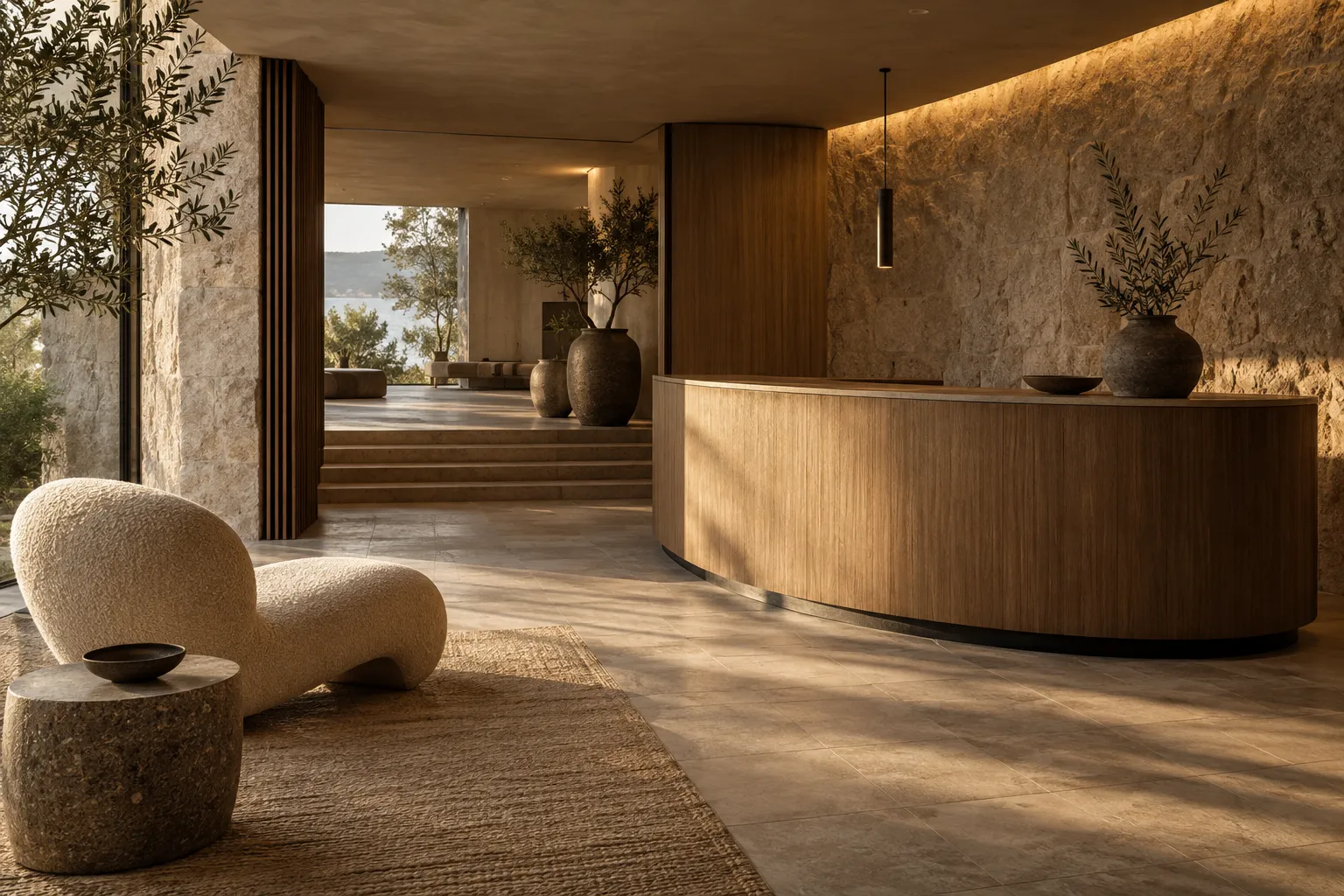
Travel gives us the chance to encounter rooms designed for people who have never seen them before. A hotel room must explain itself quickly; a station must guide movement; a café must make a stranger feel comfortable enough to stay. The most useful design lessons are often found in these ordinary details rather than in a dramatic lobby or famous facade. A place may show how light, storage, acoustics, and circulation can reduce effort in everyday life. The point is not to copy a hotel room at home. Hospitality and public interiors have budgets, staff, regulations, and patterns of use unlike a private residence. Instead, observe why an arrangement works. Notice where your bag naturally lands, how you find the bathroom at night, and whether a seat invites you to pause. Take the principle home, not necessarily the object.
Watch the first minute of arrival
The experience of a place begins before you see its main room. Where do you stop, turn, put down a bag, or look for a sign? A good arrival sequence reduces uncertainty. In a hotel room, a clear luggage surface and visible light control can make the space feel easy immediately. In a museum or café, the entry may allow a moment to orient before asking for a decision.
Notice whether the route is obvious without excessive signage. Materials, lighting, and the position of furniture can guide people toward a reception desk or seating area. A threshold may feel welcoming because it offers a clear view and enough space to pause. It may feel stressful because the door opens directly into a crowded route or because there is nowhere to stand while finding a reservation.
At home, the same observation can inform an entryway. A hook near the door, a shelf for keys, and a light that is easy to reach may be more valuable than a decorative console that sits outside the natural path. The lesson is about the sequence of actions, not the style of the building.
Notice how spaces explain their purpose
Well-designed places often make their uses legible without labels. A low light and comfortable chair suggest a place to linger; a clear surface and brighter task light suggest work. A shared table in a lobby can invite casual use, while a tucked-away seat offers privacy. Watch how furniture, distance, and light communicate the expected behavior of a space.
Consider the edges between activities. A café may separate a busy ordering zone from quieter seating through a change in floor finish, a shelf, or a shift in ceiling height. A hotel room may distinguish sleeping from working with the position of a desk and a separate lamp. The transition need not be a wall. It can be a change in orientation that helps people understand where to go and how to use the space.
This is useful in open-plan homes, where activities can blur. Instead of copying a lobby's furniture, borrow its clarity: give reading, dining, and working their own anchors. A room feels more generous when its uses are understandable and do not compete for the same surface.
Study light at different times
Travel interiors are often experienced across a full day, making changes in light easy to notice. A hotel room may feel calm in daylight but too bright at night if one ceiling circuit does all the work. Another may provide a reading lamp, soft background light, and a path to the bathroom that can be used without waking a companion. These details reveal how much control matters.
Observe the relationship between windows and artificial light. Are curtains easy to use? Does a desk receive glare? Is a mirror well lit without harsh shadows? Does a restaurant table remain comfortable when daylight fades? Light is most successful when it supports the activity and the time of day, not simply when a fixture looks distinctive.
At home, translate the lesson into separate layers and controls. A portable lamp may solve a reading problem; a more flexible window treatment may improve a desk. Avoid assuming that a dramatic installation from a public space belongs in a small room. The principle is to give people useful choices of brightness and direction.
Pay attention to sound and privacy
Sound can determine whether a place feels restful even when its visual design is beautiful. Listen to how a restaurant balances conversation and background noise, whether a corridor carries footsteps into rooms, and how a public space offers quieter pockets. Soft materials, ceiling treatments, furniture layout, and distance can affect the experience, though they do not necessarily provide true sound isolation.
Notice where privacy is achieved without complete enclosure. A chair turned away from a busy route may offer a more comfortable conversation than one in the center of the room. A booth or low partition can create a sense of shelter while preserving a connection to the wider space. In a hotel room, the placement of a desk or bed relative to the door can change how exposed the occupant feels.
At home, this may translate into seating orientation, a rug in a reverberant room, or a work area away from the busiest path. Be realistic about the limits. A curtain or open shelf can change the visual experience but will not make a private call soundproof. The observation is useful because it helps distinguish what the room actually needs.
Examine where everyday objects go
Design is often most visible in the placement of ordinary things. Is there a bedside surface large enough for a phone and a book? Where do damp towels hang? Does a restaurant provide a comfortable place for a bag? Are outlets accessible without moving furniture? A room can be impressive yet tiring if these needs are treated as afterthoughts.
Look at how storage is balanced with openness. A hotel might use an exposed rail to keep a small room visually light, but that may be less suitable for a home where clothes remain for months rather than days. A compact bathroom may hide supplies neatly while leaving a clear place for the items used each morning. Ask what the arrangement assumes about duration and maintenance.
Translate the useful part to your home. If a travel room feels unusually easy to inhabit, perhaps the bag surface, hook, or bedside light has removed a repeated inconvenience. The solution may be a small shelf or a different drawer assignment rather than a major renovation. Good details often work because they meet an action at the point where it happens.
Read the material choices through use
Travel exposes materials to heavy use, frequent cleaning, and different climates. A surface that looks luxurious may also have been chosen because it can be maintained efficiently. Look at the places people touch: chair arms, door handles, tables, and floor transitions. Do they still feel pleasant after wear? Do marks add character or make the space look neglected?
Observe how materials meet. A durable floor may continue from an entry into a shared room, while softer textiles signal a place to rest. A timber surface may warm an otherwise restrained interior. The interest often lies in contrast and repetition rather than an expensive material alone. A few coherent finishes can make a complex place feel calm.
Remember that a hotel has staff and replacement cycles that a home may not. A delicate finish can look beautiful when maintained daily by professionals but become burdensome in ordinary domestic life. Bring home the material principle—texture, warmth, clear transitions—while choosing products suited to your own care routine and local conditions.
Observe seating and the invitation to stay
The shape and arrangement of seats reveal who a space is designed for. A café with small upright chairs may encourage a short visit; a lobby with varied seats may accommodate waiting, reading, and conversation. Notice whether tables are within reach, whether people can move between seats, and whether a chair feels comfortable beyond the first minute. A seat's appearance is only part of its design.
Look for choice. Some people want a quiet corner; others prefer to watch the room. A good public interior may offer both without making either feel secondary. At home, a similar variety can be created with a sofa, one supportive chair, and lighting that gives each a purpose. The room need not contain many pieces, but it should allow more than one comfortable posture.
Pay attention to what happens when the space is busy. Can people pass behind occupied chairs? Does a table become an obstacle? The best travel interiors often retain their clarity under use. That is a valuable test for a home layout as well.
Look at wayfinding without copying signage
In an unfamiliar building, finding the right route can be effortless or exhausting. Notice how sightlines, light, and repeated materials help you understand where to go. A visible stair, a brighter destination, or a clear change in floor texture may guide movement before you read a sign. The route can be intuitive because the architecture tells a story in sequence.
At home, wayfinding is less formal but still important. Guests should be able to find the bathroom or move from entry to living room without crossing private work or storage zones. Children and older visitors may benefit from clear paths and consistent lighting. A long hallway can feel less like wasted space if it connects to daylight or a useful destination.
Do not assume that every visual cue from a large public building belongs in a residence. The scale is different. A subtle material continuation or an unobstructed view may be enough. The practical lesson is that a space should be easy to understand from the position where a person first encounters it.
Bring home a principle, not a replica
When a place leaves a strong impression, write down what happened before searching for a similar object. Did you sleep well because the room was quiet and dark? Did a café feel welcoming because the chairs were comfortable and the light was low? Did a small room feel generous because luggage had a clear place and the window remained visible? Naming the effect helps separate the underlying design from its particular materials.
Take a photograph of a detail only when appropriate and permitted, then add a note about why it worked. Without that note, a picture of a beautiful lamp may lead to a purchase that solves none of your home's real problems. Ask whether the idea depends on staff maintenance, a different climate, or a scale you do not have. Adapt it to the conditions of your own space.
Try making a short observation list after a trip. Describe one moment of ease, one moment of friction, and one detail you would consider changing at home. The moment of ease might be finding a light switch without searching; the friction might be a beautiful chair with no nearby table. For each detail, ask what behavior it supported and what resources it required. A hotel may use concealed storage because staff reset the room daily. At home, visible hooks may be more practical because people need to put things away quickly. A restaurant's moody lighting may feel wonderful over dinner but unsuitable for a table used for schoolwork. These comparisons prevent travel inspiration from becoming a collection of misplaced purchases. They also reveal that good design is often about anticipating a sequence of actions rather than inventing a dramatic form. The most portable ideas are usually the ones that make ordinary movements feel natural.
The best travel observations can be surprisingly modest: a switch within reach, a bench at the right point in an entry, a curtain that controls light well. Write down the context in which each detail worked, including the time of day and the task it supported. They are worth noticing because they make daily actions smoother. A home becomes better through these small, carefully translated lessons, not by imitating the surface appearance of a place visited for one night.
Photograph the detail and note why it works before shopping for a similar object.
These are general design considerations. Product dimensions, materials, installation requirements, and care instructions should be checked with the relevant maker or professional before purchase or work begins.