A kitchen countertop is seen across the room and used at close range every day. It receives groceries, hot pans, wet glasses, sharp tools, and frequent cleaning. A material that looks beautiful in a sample can feel very different when installed across a long run with seams, edges, and a sink cutout. The right choice is therefore a balance of appearance, care, repair, installation, and the household's tolerance for change over time. There is no universal winner. Natural stone, engineered surfaces, timber, solid surface, laminate, tile, and metal each create different opportunities and obligations. Products within a category also vary, so broad labels should begin a conversation rather than end it. Before visiting a showroom, write down how the kitchen is used and which forms of wear would bother you. Then ask sellers and fabricators for current, product-specific guidance. This approach makes comparisons more honest than choosing from a photograph or a claim that one material is simply "best."
Define the work the counter must do
Map the main tasks across the kitchen. Where is food prepared? Where do people set bags or small appliances? Does the counter double as a dining surface or a place for children to work? A household that cooks several times a day may prioritize easy cleaning and freedom from worry. Another may value a particular material character and be comfortable with regular care. Neither preference is wrong, but the choice should reflect daily use.
Think about the users as well as the tasks. Someone who frequently slides heavy equipment across the counter may care about abrasion. A family with young children may focus on quick cleanup. A keen baker may want a broad, uninterrupted area. Identify the busiest zones and the quietest ones; some kitchens can use different materials in each, but transitions and maintenance then need careful planning.
List your non-negotiables separately from preferences. For example, a certain look may be desirable, while compatibility with an undermount sink may be essential. Budget should include fabrication, edge work, cutouts, installation, and any future care, not only the quoted price of a slab or sheet. This brief keeps the comparison grounded when attractive samples begin to compete for attention.
Compare appearance at full scale
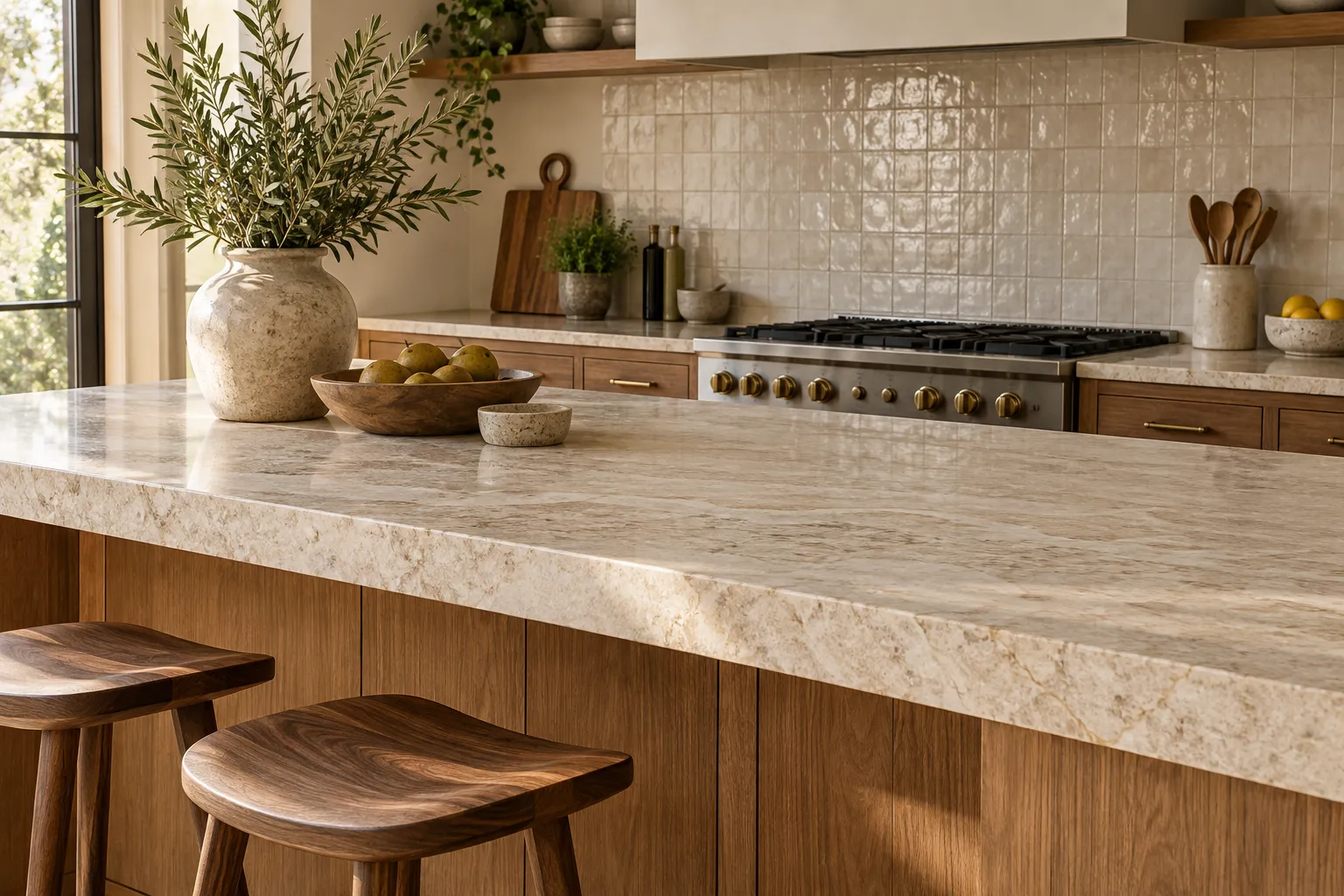
A small sample rarely shows how a material will look across a complete kitchen. Natural stone can have variation and veining that changes from one slab to another. Manufactured surfaces may have repeated patterns or a different depth of color when seen over a long run. Timber brings grain and joints; tile introduces grout lines; laminate edges can influence the overall impression. Ask to see a large installed example or the actual slab or batch when that is possible.
Place samples beside cabinets, flooring, and wall finishes in the light of the room. A neutral that looks warm in a showroom may appear cool beneath your windows. Glossy finishes can reflect fixtures and fingerprints, while matte finishes may have their own cleaning characteristics. Look at the surface from standing and seated positions. If the counter is visible from a living area, its pattern and sheen will affect more than the cooking zone.
Consider where seams are likely to fall. A dramatic pattern may be difficult to join convincingly, while a quieter surface can make a seam less noticeable. Ask a fabricator to show the likely layout before approving an expensive material. The installed composition, not the isolated sample, is the design decision.
Understand what everyday care really involves
Care instructions vary by product, finish, and treatment. Ask for written guidance on cleaning, stain response, sealing where relevant, and products to avoid. Do not assume that every member of a broad material category behaves the same way. A useful question is not "Is this low maintenance?" but "What must I do after an ordinary spill, and what happens if I do not notice it for an hour?"
Think about the household's likely behavior. If everyone reliably uses boards, trivets, and quick wipe-downs, a material with more demanding care may be a pleasure to own. If the counter is shared by people with different habits, a more forgiving surface may reduce tension. Maintenance is a design quality because it influences how freely the kitchen is used.
Also ask how the surface will change with time. Some people enjoy patina and visible signs of life; others want a consistent appearance. Neither preference can be inferred from a showroom image. Request examples of aged installations, not only new ones, and ask which marks can be treated locally and which are permanent.
Examine heat, scratches, and impact separately
Materials respond differently to heat, abrasion, and impact, and a single durability label can conceal those distinctions. A surface may resist one kind of wear while being vulnerable to another. Product-specific guidance matters, especially near cooking equipment and small appliances. Use protective boards and trivets according to the maker's instructions rather than treating a general category reputation as permission to ignore them.
Edges and corners deserve particular attention. A heavy object dropped near a cutout or narrow strip may create a different risk than one placed in the middle of a broad run. Ask how the chosen edge profile affects appearance, touch, and potential repair. A very sharp-looking detail may be less comfortable where people lean or children move past. The best edge belongs to the room's style and its ordinary traffic.
Consider test claims carefully. A showroom may demonstrate a material in a controlled way, but your kitchen includes seams, installation details, and years of changing use. Ask for written product documentation, warranty exclusions, and care limits. Clear information is more useful than a dramatic one-minute demonstration.
Plan sinks, appliances, and joints early
The counter is not a flat rectangle once sinks, hobs, taps, outlets, and appliances are included. Their placement affects seam positions, support, and cleaning. Decide on major fixtures before final fabrication measurements, and confirm the specifications with the installer. Changes made late can be costly or impossible. A beautiful surface can feel awkward if a sink edge traps water or a seam crosses the most prominent part of the kitchen.
Discuss how the surface meets walls and splashbacks. An uneven wall may require a particular detail; a thick-looking edge may be built up differently from the material's main thickness. A waterfall end can be striking but increases the amount of material and the importance of pattern alignment. Ask to see drawings or clear examples of the proposed detail rather than relying on a verbal description.
Installation is skilled work. Cabinets must be suitable and level, and some materials need particular support or handling. Use a qualified fabricator and installer for the selected product. The quality of templating, joining, and finishing can determine whether an otherwise good material feels satisfying in the finished room.
Consider repair before a problem occurs
Small accidents are part of kitchen life. Ask what a scratch, chip, stain, or damaged edge would require to repair on the specific product and finish. Can a local area be treated, or would a whole section need replacement? Will a repaired area blend visually? Who is qualified to do the work, and are spare material or color matches likely to be available later?
These questions matter especially when the countertop is the dominant visual surface. A material that can be renewed may have value even if it requires occasional care. A surface that resists common marks may be attractive but could be more difficult to repair if damage does occur. The trade-off is not simply between strong and weak materials; it is between different patterns of wear and different recovery options.
Keep records of the product name, finish, installer, and care instructions. If the kitchen changes or a repair is needed years later, that information can save time. It also prevents someone from applying the wrong cleaner based on a guess about what the surface is made of.
Weigh cost as a complete project
Countertop prices are often discussed per unit of area, but a kitchen project includes more. Slab size and layout may affect waste. Cutouts, edge profiles, seams, delivery, removal of an old top, and installation can change the total. A less expensive material with complicated detailing may cost more than expected. Ask for an itemized quote that describes what is included and what might be charged separately.
Budget for the decisions around the counter. A new sink or tap may be needed; splashback and wall finishes may need alteration; cabinets may require assessment. If a kitchen remains in use during a renovation, time without the counter has a practical cost as well. Get a realistic schedule from the installer rather than assuming the surface can be changed in one easy step.
Compare long-term value in terms of use, care, and possible repair. A lower initial price can be exactly right if the material meets the brief and can be replaced straightforwardly in the future. An expensive surface may be justified when its appearance and performance suit a kitchen you expect to keep for many years. Choose the level of investment with clear eyes, not by category prestige.
Use a side-by-side decision sheet
For each shortlisted product, record the exact name and finish, the appearance in your room, written care instructions, expected seams, edge options, repair path, warranty terms, installed quote, and availability. Ask the same questions of each supplier. This makes the comparison fairer than collecting unrelated brochures. If an answer is unclear, mark it as unknown rather than filling the gap with a general assumption.
Handle samples as realistically as the supplier allows. View them near the sink and in evening light. Feel the edge profile, observe reflections, and compare a larger image of the finished surface. If a particular mark would bother you greatly, ask to see an aged sample or an installation that has been used for some time. A good decision includes the material's likely future appearance.
Discuss the shortlisted options with the person who will fabricate and install them. They can identify practical constraints that a showroom display may not reveal. The aim is not to find a material with no drawbacks, but one whose trade-offs match the kitchen and the people using it.
If two options remain close, rank the criteria instead of averaging them. A household that dislikes visible staining may give care and repair more weight than dramatic pattern. Another may accept extra maintenance to gain a particular tactile surface. Think about which drawbacks you would actually notice each day. A small difference in price may matter less than a cleaning routine that fits naturally into the household; a large difference may be better spent on improved lighting or cabinetry. Ask each supplier what is excluded from the quote and what would cause a change order. This is also the moment to confirm who is responsible for measuring, transporting, and fitting the surface. The comparison becomes more useful when every option is judged as an installed, lived-with countertop rather than a sample with an appealing name.
Choose for use, then enjoy the character
The final choice should let you cook and live without constant second-guessing. Some households will welcome a natural surface that changes with time. Others will prefer a more uniform appearance and simple routine care. Both can make excellent contemporary kitchens when detailed well. The material should support the room's work and contribute to its atmosphere.
Before placing an order, confirm the exact product, finish, batch or slab selection where relevant, edge detail, seam plan, sink and appliance specifications, installation scope, and care documentation. Review the drawing in the actual kitchen if possible. It is easier to adjust a plan than a finished countertop.
When the surface is installed, follow the maker's guidance from the first day. Keep the documentation available to everyone using the kitchen. The most satisfying countertop is not necessarily the one that looked most dramatic under showroom lights. It is the one that continues to feel appropriate during breakfast, preparation, cleaning, and years of ordinary use and changing routines.
Choose with a real sample, a written care routine, and a complete installation quote.
These are general design considerations. Product dimensions, materials, installation requirements, and care instructions should be checked with the relevant maker or professional before purchase or work begins.