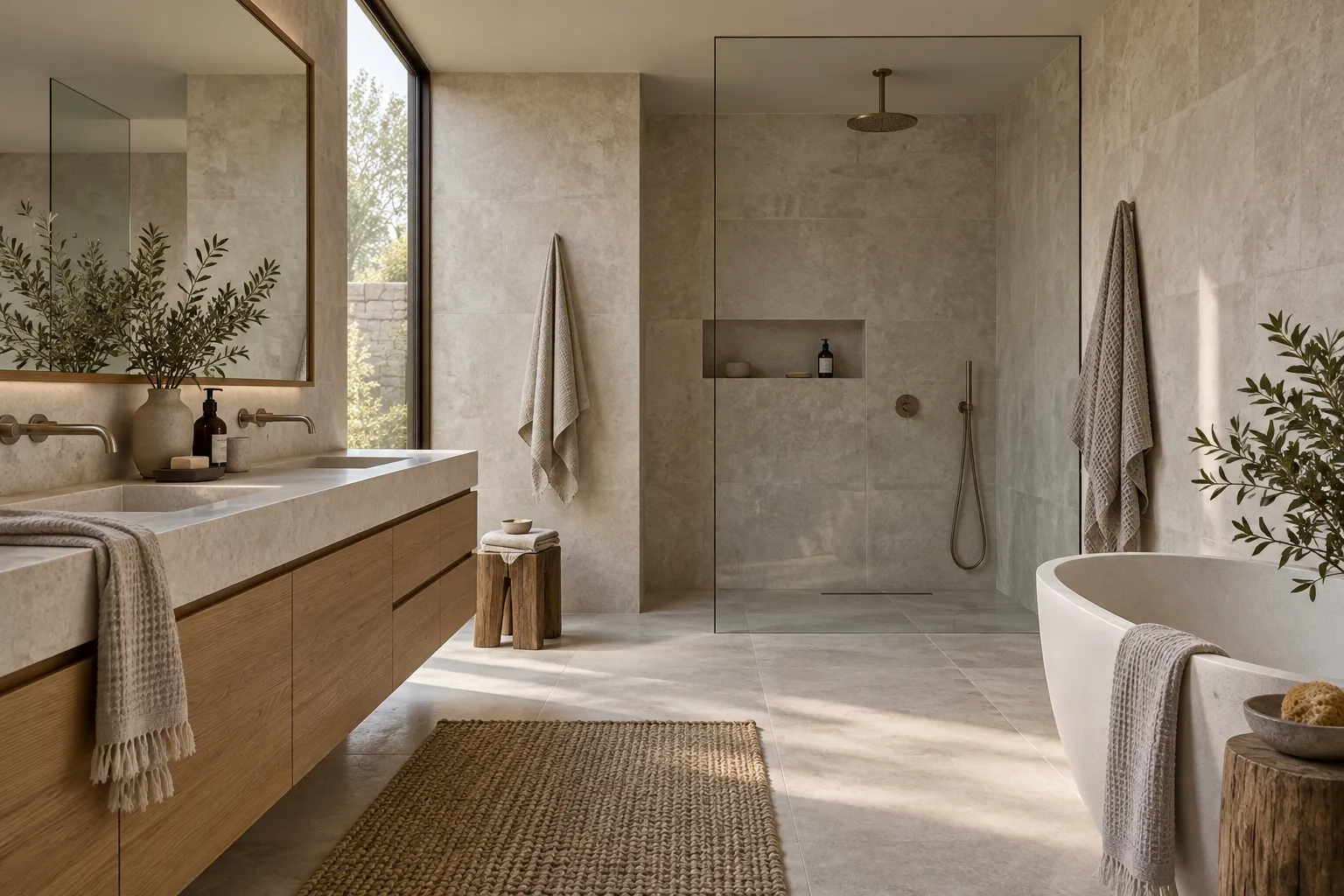
A bathroom is experienced at close range. Feet meet the floor when it is wet, hands touch taps and cabinets, and light reveals every surface in the mirror. Materials that look serene in a photograph must also tolerate moisture, frequent cleaning, and the small impacts of daily use. A bathroom that ages gracefully begins with water management and practical access, then builds warmth through texture, proportion, and a restrained selection of finishes. The visual choices cannot be separated from construction. Waterproofing, drainage, ventilation, and the suitability of products for their locations need qualified local review. A beautiful tile does not compensate for water trapped behind it, and a dramatic basin is less enjoyable when the surrounding counter is hard to clean. The design goal is a room that remains comfortable and understandable after the first-day polish has faded.
Resolve the wet areas before choosing color
Identify where water will regularly land: inside a shower, around a bath, beside a basin, and on the floor near the door. These zones may require different materials and construction details. Discuss waterproofing, slopes, drainage, and ventilation with qualified local professionals before finalizing surface choices. Requirements vary by building and location, so a reference image is not an installation specification.
Think about what happens when the room is used quickly. Does a shower spray reach a cabinet? Does water collect at a threshold? Can a towel be reached without dripping across the floor? A layout that directs everyday moisture away from vulnerable materials reduces the burden on cleaning and repair. A small change in screen position or storage location may be more valuable than a more expensive finish.
Ask to see how transitions will be detailed. The junction between shower floor and wall, the base of a vanity, and the edge of a niche are not minor visual lines; they are places where construction and maintenance meet. Clear drawings and product documentation make the final appearance more predictable.
Compare floors by grip, comfort, and cleaning
Bathroom flooring should be assessed in the condition in which it will be used, including when wet. A polished sample may feel different from a textured one, but surface labels and suitability should be checked for the specific product and location. Ask the supplier and installer how the finish performs in a bathroom and what cleaning it requires. Do not choose solely by color or the appearance of a dry showroom tile.
Consider the scale of the room and the size of pieces. Large tiles can create fewer visible joints, while smaller formats may suit slopes or curved details better. More grout lines also mean more joints to clean. The right format depends on drainage, substrate, and installation plan as well as visual preference. A qualified installer can explain the practical implications for the proposed floor.
Feel the surface underfoot and examine it in the room's light. Very rough textures may provide reassurance but be harder to clean; very smooth finishes can raise concerns when wet. Ask about maintenance and use in a household with children, older visitors, or anyone who needs secure footing. The floor should look calm and feel dependable.
Use wall materials where they are genuinely needed
Tiling every wall can create a continuous look, but it may add cost and make the room feel harder. Painted areas can bring softness where they are suitable and protected from direct water. The exact boundary depends on the layout and product system; let the qualified installer determine where moisture-resistant construction is required. Do not extend a decorative finish into a wet zone without understanding its limitations.
Think about the visual rhythm of tile. A strong pattern on every surface can overwhelm a small room, while one considered wall or niche may provide enough character. Grout color, tile edge, and corner details affect the finished result as much as the tile face. Request a mock-up or photographs of completed junctions so you understand how the materials meet.
Wall surfaces are seen in reflection as well as directly. A mirror can double the impact of a pattern or a dark finish. Stand where a person will use the basin and consider the view behind them. A quieter surface may make the room feel more restful and allow light and objects to take the lead.
Choose a vanity that tolerates real use
The vanity holds plumbing, storage, and a frequently wet surface. A floating design can make the floor look more open, but it still needs suitable wall support and must allow access to services. A floor-standing piece may offer different storage and installation options. Choose the format around the room's structure and the items it must hold, not only its silhouette.
Inspect the basin and counter relationship. Is there enough space for everyday items without crowding the tap? Are corners easy to wipe? Does water tend to sit around the base of the basin or run toward vulnerable joinery? A beautiful stone or timber-look surface may have care requirements that differ from a more forgiving manufactured top. Read the actual product guidance rather than assuming a material family behaves uniformly.
Plan the inside as carefully as the outside. Deep drawers can hide clutter if plumbing allows them; shallow compartments may keep small items visible. Leave room for towels, cleaning supplies, and replacement toiletries. A vanity that looks spare only because it has nowhere for these objects will soon feel busy on top.
Try arranging the objects you use every morning on a cardboard outline of the proposed counter. This reveals whether the basin leaves enough dry space and whether a narrow shelf would help. Consider who shares the room and whether several people need access at the same time. A double basin may seem desirable, but in a modest bathroom it can consume storage and counter area that would be more useful than a second sink. A single well-placed basin with generous adjacent surface can sometimes support a shared routine more comfortably. Choose the configuration by observing use, then let the joinery express that choice cleanly.
Think about joints, edges, and hardware
Bathrooms contain many small transitions: tile to paint, basin to counter, glass to wall, cabinet to floor. Their quality determines how the room looks up close and how easy it is to maintain. Ask how edges will be finished and what materials are specified at joints. A minimal line in a rendering may require careful construction in reality. Budget time and attention for these details.
Hardware is touched daily. Test the feel of handles and taps if possible. A finish may look warm in a sample but show marks differently in use, so ask about care and replacement parts. Choose a consistent approach without requiring every metal surface to match exactly. A restrained family of tones can feel more natural than an entire room selected from one catalog range.
Check access for future maintenance. Can a tap be repaired without removing a large decorative panel? Can a seal be inspected and renewed? A bathroom should not become difficult to service in pursuit of seamless appearance. The best details are calm because they are resolved, not because important functions have been hidden beyond reach.
Bring warmth through material contrast
A bathroom can feel cold when every surface is hard, glossy, and pale. Warmth may come from a matte wall, a timber-toned cabinet, a woven basket away from water, or towels with visible texture. These additions do not require a crowded decorative scheme. Choose a few materials that respond differently to light and touch, and let their contrast give the room depth.
Natural materials can be beautiful but need to suit the moisture and cleaning conditions of their exact location. A timber element protected from direct splashing may have a different life from one beside an open shower. Stone varies by type and finish. Ask for product-specific care instructions and examples of aged installations. The aim is to enjoy a material's character without being surprised by the work it requires.
Color can also soften the room. A warm neutral is one option, but a deep wall tone or colored cabinet can create an intimate atmosphere when balanced with good light. Sample finishes in the actual bathroom. Artificial lighting and mirrors can change their appearance dramatically compared with a showroom.
Give lighting distinct jobs
Bathroom lighting should help people see clearly at the mirror, move safely, and relax when full brightness is unnecessary. A single overhead fitting often creates unhelpful shadows at the face. Consider how light reaches the mirror from the sides or through a diffused source, and how the rest of the room is illuminated. Test the effect at the positions where someone will actually stand or sit.
Glare can be amplified by mirrors, glazed tile, and polished taps. A striking fixture may be unpleasant when viewed directly in reflection. Observe the room from several angles and choose shades or placement accordingly. If a bath is part of the room, a gentler setting can make it more comfortable without compromising the brighter task light at the basin.
Electrical work in bathrooms has specific safety requirements that vary locally. Use qualified professionals and products approved for the intended location. Lighting is part of the material story because it changes how every finish appears, but safety and serviceability must lead the design.
Design for cleaning and ventilation
Every bathroom requires regular care. Fewer awkward ledges, accessible corners, and surfaces that can be cleaned with methods acceptable to their makers make that work easier. A beautiful recessed shelf can become a place where water sits if its detail is poorly considered. A freestanding object can make the floor harder to clean. Evaluate each feature both as a visual element and as a surface someone will maintain.
Ventilation helps the room dry after use. Confirm the existing system's condition and requirements before adding finishes that could be affected by persistent moisture. A mirror that constantly fogs or surfaces that remain wet long after a shower may signal a practical issue that a new tile will not solve. Qualified local advice is important where building systems or moisture damage are involved.
Store towels so they can dry and keep cleaning supplies accessible but secure. Small daily habits affect how materials age. The design should make good habits easy rather than depend on constant vigilance.
Make the final selection as a system
Lay out samples of floor, wall, vanity, metal, and textile together in the bathroom. View them in daylight if available and under the proposed artificial light. Check how many competing textures and tones are present. A room can feel rich with a small palette when the finishes have varied depth; it can feel busy when every surface demands attention.
Ask the installer to review the selected products together, including their suitability for wet areas, edge details, and maintenance. Confirm who is responsible for waterproofing, ventilation, and any structural or electrical changes. Keep product names and care documents for future reference. If an answer is uncertain, resolve it before ordering rather than assuming the materials will work together.
Compare alternatives with a short list rather than an overwhelming board of samples. For each floor or wall finish, note how it feels, how it is cleaned, where it may be used, and how its edges will be finished. For cabinetry, ask about protection from splashes and access to plumbing. For metal finishes, check whether replacement parts are available. These questions bring the discussion back to ownership. A material that is slightly less dramatic in the showroom may make the finished room far easier to enjoy. When the practical information is clear, aesthetic judgment becomes more confident rather than more constrained.
A bathroom that ages gracefully is not one that never changes. It is one whose surfaces can be cared for, whose water is managed, and whose details remain pleasant to touch and use. Review the care plan periodically as products age. When the hidden construction and visible materials support one another, the room can stay calm long after installation day.
Resolve water and ventilation details, then choose surfaces for grip, cleaning, and touch.
These are general design considerations. Product dimensions, materials, installation requirements, and care instructions should be checked with the relevant maker or professional before purchase or work begins.