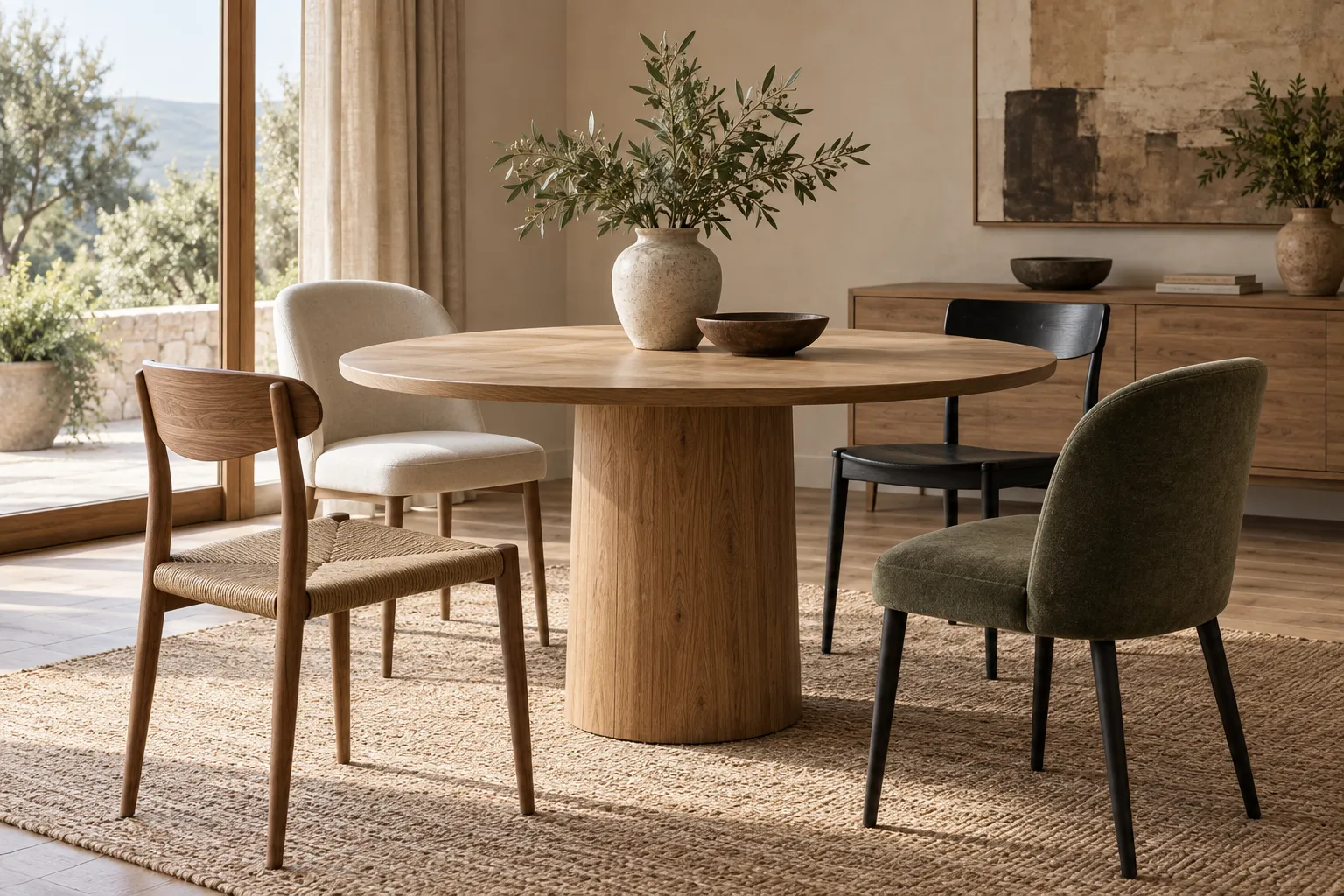
Dining chairs are purchased in multiples, so a small mistake in scale or comfort repeats around the table. A chair that photographs beautifully may be awkward to pull out, too low for the table, or uncomfortable after the first course. The most successful dining area makes gathering easy: people can sit down without maneuvering, lean back during a long conversation, and stand without disturbing everyone else. Form matters, but it should work in the service of that experience. Begin with the table you own or intend to buy. Its height, apron, leg placement, and shape set the conditions for every chair. Then consider the people who use it, how long meals tend to last, and whether the table also supports homework or work. The right chair is not a universal design icon. It is the one that fits this table, this room, and these habits while remaining satisfying to look at when nobody is seated.
Measure the table before comparing chairs
Start with the height from floor to tabletop and, more importantly, the clear space beneath the table. An apron or support rail can reduce legroom even when the overall table height seems ordinary. Measure the distance between legs or base elements where chairs must fit. A wide chair with arms may look elegant in isolation yet fail to tuck under a table or prevent adjacent diners from sitting comfortably.
Check the room around the table as well. Pull a current chair out as if someone were sitting and see what remains of the walkway. If the dining area sits on a main route, a bulky silhouette may make every meal feel cramped. A slimmer chair or fewer chairs kept at the table, with extras stored elsewhere, may serve the room better than a permanently crowded arrangement.
Do not rely on one measurement. Seat height, total width, arm height, back angle, and depth all affect fit. Product pages sometimes omit details that matter to a particular table; ask the maker or seller for them. The exercise can prevent a costly mismatch before color or finish becomes a distraction.
Test the seated relationship, not the chair alone
A chair can feel comfortable in a showroom but not work at a specific table. Sit at the intended table if possible, or reproduce the height with a comparable one. Can your feet rest comfortably on the floor? Can you lean toward a plate without feeling pitched forward? Is there enough room beneath the tabletop for your thighs? Does the back support a relaxed conversation after the meal? These practical tests reveal more than a brief sit while looking at the chair from the side.
Seat depth deserves attention. A deep seat may suit a taller person but leave a shorter diner without back support while sitting close enough to eat. A shallow seat can encourage upright posture but feel less comfortable during a long evening. The shape and angle of the back matter as much as upholstery. A gently supportive timber chair may be more comfortable than a padded chair with the wrong geometry.
Different household members may prefer different seats. A pair of armchairs at the table ends can provide variety while armless chairs keep the sides flexible, provided the arm height fits. If someone needs extra support for sitting or standing, consider that early rather than treating it as a later accessory.
Decide what role arms should play
Arms can make a dining chair feel more like a lounge seat, encouraging people to stay after eating. They can also increase width, prevent chairs from sliding beneath the table, and make a narrow dining area harder to navigate. Choose them for a reason. At a generous rectangular table, end chairs with arms may work well. Around a compact round table, four armless chairs may allow more fluid movement.
Check the actual arm height against the table clearance, including the apron. An arm that catches the edge will keep the chair farther into the room. Also consider how the arm meets the body. A slender arm may support getting up without dominating the silhouette; a very low decorative arm may offer little practical benefit.
Mixing armed and armless chairs can be useful, but their seat heights and visual weights should relate. A large upholstered captain's chair can make delicate side chairs look incidental. Instead of matching every detail, connect them through a material, color, or line. The collection should feel intentional and comfortable, not like a compromise forced by leftover space.
Choose a back that suits long meals
Dining chair backs influence comfort and the room's visual rhythm. A high, solid back offers support but can form a dense wall around the table, especially in a small apartment. A low or open back keeps sightlines clearer, yet may not suit everyone for long periods. The best choice depends on both the seated body and the view through the room.
Try leaning back naturally rather than sitting in a perfectly upright showroom pose. Does the back meet you where support is useful? Are edges smooth where arms or shoulders touch? Is the chair stable when someone shifts position? A chair should accommodate small movements through a meal. Comfort is not only about softness; it is also about whether the shape allows the body to settle.
If you cannot try the chair, compare its profile and dimensions with a model you know. Read return terms carefully and consider ordering a single chair before a full set when practical. A photograph can show silhouette and finish; it cannot establish how the back feels to a particular person.
Match materials to the way the table is used
Timber, metal, upholstery, and molded materials each bring a different combination of touch, visual weight, and care. A timber chair can add warmth and may be easy to wipe, but finish and construction affect how it wears. An upholstered seat can soften a hard dining area, yet spills and crumbs make cleaning important. A metal frame can look light or precise but may feel different against the body depending on its design.
Ask for care instructions and examine the finish closely. Can a fabric be spot cleaned? Is the cover removable or replaceable? How does the chair handle frequent movement across the floor? Floor protectors may be needed, and their suitability depends on both chair leg and floor surface. A delicate finish may be lovely for occasional formal meals but less reassuring at a table used by children for projects.
Choose materials in relation to the room rather than trying to match the table exactly. Chairs can contrast with a timber table through color or texture while sharing a similar warmth. Exact matching can make the set feel static; deliberate contrast can give it character. The practical requirement is that the pieces can live together under the same patterns of use.
Consider weight, movement, and storage
Dining chairs are moved repeatedly. A heavy chair may feel substantial but become irritating to pull out several times a day. A very light chair may be easy to handle yet feel less stable to some users. Try moving it with one hand and returning it to the table. Listen for scraping and notice whether the legs catch on a rug edge. If the table is often extended, consider where additional chairs will be stored and whether they are comfortable to carry.
Stackable or folding chairs can be useful for occasional guests, but they should be evaluated with the same care as permanent chairs. Check how they store, whether surfaces rub when stacked, and whether their seating comfort suits the length of a typical gathering. If extra chairs spend most of their lives in a closet, ease of storage may matter more than perfect visual continuity.
Stability matters for everyone and especially for households with children. Follow the maker's guidance for use and maintenance. Inspect joinery or fasteners periodically as part of ordinary care. The right chair should be easy to live with between meals, not only pleasant during them.
Use repetition to give the room rhythm
A set of chairs creates a repeated pattern visible from across the room. The spacing between backs, the line of their top edges, and the amount of open space beneath them all affect how the dining area feels. Several solid high backs can create a strong architectural presence; open backs may let light travel through. Neither is automatically better. Consider what the room needs visually when the chairs are pushed in.
If mixing designs, choose a principle that holds them together. A shared seat height, related timber tone, or repeated curve can make different chairs feel like a collection. Limit the number of competing ideas. Four unrelated statement chairs around a small table may create more visual noise than personality. A single contrasting pair at the ends may be enough.
The table and chairs should also relate to surrounding lighting and circulation. A pendant centered over the table can reinforce the composition, but it does not fix chairs that are too large or difficult to use. Get the seating relationship right first; styling will be easier afterward.
Compare total cost and long-term care
The price of one chair may look reasonable until multiplied by six or eight. Decide which qualities justify spending more: comfort for daily meals, replaceable components, a finish that can be maintained, or construction information you can trust. Avoid assuming a high price guarantees every one of these. Ask specific questions and compare answers across candidates.
Consider the possibility of future additions. If you buy only four now, will the model or finish likely be available when the table changes? If not, would a deliberate mix still work? A design with a distinctive, difficult-to-match color may make later expansion harder. This is not a reason to choose the safest possible chair, but it is worth knowing before purchase.
Read return and delivery terms for the full set. Packaging, assembly, and potential damage can be significant with multiple chairs. Keep care information and any spare parts together. A dining area is used and adjusted over years; buying with maintenance in mind can make it more rewarding to own.
Make a final test around the table
Before committing, picture a meal with every planned seat occupied. Can people get in and out without asking neighbors to move? Can a person at the end see and join the conversation? Is there enough room for serving dishes and for chairs to move without hitting a wall? Run the same test during the day and after dark, when the room's mood and light change.
If possible, borrow or order one sample chair and live with it for a few days. Use it for a long meal, a short task at the table, and an ordinary breakfast. Notice whether the back still feels good after time, whether the finish is easy to clean, and whether moving it becomes effortless. If a trial is not possible, use measurements and return information to reduce uncertainty.
When several designs seem equally attractive, return to the room's most common use. A household that eats quick meals at a kitchen table may value light chairs that are simple to clean. People who linger over long dinners may prefer more support and a softer seat. A table that doubles as a work surface might need chairs that allow upright posture for focused tasks without feeling formal at dinner. These differences are more useful than a ranking of styles because they describe what the chair must do. If two members of the household have very different needs, a mixed arrangement may be more honest and more comfortable than insisting every seat be identical. The visual scheme can still be coherent through a shared finish, scale, or color. Comfort is part of the composition, not a concession to it.
The best dining chairs invite people to stay because they remove small discomforts. They suit the table, make movement easy, and create a visual rhythm that belongs in the room. Their design earns attention through use as much as through appearance.
Check fit under the table, seating comfort, and movement around every place setting.
These are general design considerations. Product dimensions, materials, installation requirements, and care instructions should be checked with the relevant maker or professional before purchase or work begins.