Modular shelving promises flexibility, but the promise is only useful when the system suits the wall, the objects, and the way a household changes. A striking arrangement may fail if its shelves are too shallow for records, too weak for books, or difficult to reconfigure. A more successful system starts with an inventory and a structural plan. It should make objects easy to reach, give a room visual rhythm, and allow adjustment without turning every change into a new project. Shelving can function as furniture, storage, display, or a light divider. Those roles lead to different decisions about depth, stability, openness, and finish. Before choosing a design, ask what the unit must hold now, what may be added later, and whether the home is likely to change. Flexibility is not an abstract virtue. It is the ability to respond to specific future needs while remaining safe and coherent in the present.
Inventory the objects first
Measure books, records, files, ceramics, baskets, and equipment rather than guessing from photographs. The tallest art book, deepest storage box, and heaviest collection may determine module dimensions. Count how much of the collection is displayed and how much needs to be concealed. A wall of open shelves can look light when staged with a few objects, but feel crowded when filled with real belongings.
Group contents by use. Frequently handled items should be easy to reach; heavy items usually belong lower; fragile display pieces need a stable position away from busy circulation. If children use the room, consider what they can reach and how the system is secured. A good storage plan is based on people retrieving and returning objects, not on creating a still life that will never be disturbed.
Leave spare capacity. A shelf loaded completely on day one has little ability to adapt. Open space can also give important objects room to be seen. The aim is not to maximize the number of items per square foot but to make the wall functional and legible over time.
Decide whether the system belongs to the wall or the room
Wall-mounted shelving can keep the floor clear and create an architectural effect, but it depends on the construction of the wall and suitable fixings. Freestanding units may be easier to move, yet they can still require anti-tip restraint and careful load distribution. A modular divider can shape an open room while allowing light through, but it must be stable from both sides and not obstruct the main route.
Study the room before selecting the format. Where are doors, outlets, radiators, vents, and window light? Will a tall unit darken a workspace or block a view? Is the floor level, and can the system be accessed for cleaning? A shelf that looks delicate in a catalog may feel imposing when it occupies an entire small wall.
Consult the maker's installation information and a qualified local professional where structural questions arise. Do not assume that any wall can carry a fully loaded system. The type of surface, fixing positions, and planned contents matter. Safety and long-term use should determine the installation method before visual details are finalized.
Understand the system's true flexibility
Modular systems differ in what can actually be changed. Some allow shelf heights to move easily, while others require disassembly or new holes. Some offer replacement parts and additional modules; others may be difficult to extend later. Ask how pieces connect, what tools are needed, and whether the layout can be reconfigured without damage. A flexible-looking arrangement is not necessarily flexible in practice.
Think about plausible changes. Could the room become a study, nursery, or shared living space? Might the collection of books grow while media equipment shrinks? A system with adjustable heights and a mix of open and closed components may respond better than one optimized for a single arrangement. However, too many possible configurations can create unnecessary cost. Buy the capabilities you are likely to use.
Check whether modules can move to another wall or home. Dimensions, wall requirements, and available spare parts affect that possibility. If moving is likely, a unit that can be disassembled and reassembled safely may offer real value. Keep installation instructions and hardware organized so flexibility remains practical years later.
It is worth comparing the cost of adaptability with the cost of a simpler piece that already suits the room. A modular system can be a sensible investment for an evolving collection, but it may be excessive for a small group of books that will stay in one place. If the main goal is display, a few well-proportioned shelves may do the job with less visual and financial commitment. If the goal is a working library that may double in size, future modules and replacement components matter much more. State the likely change in concrete terms so the system's flexibility can be evaluated rather than assumed.
Balance open and closed storage
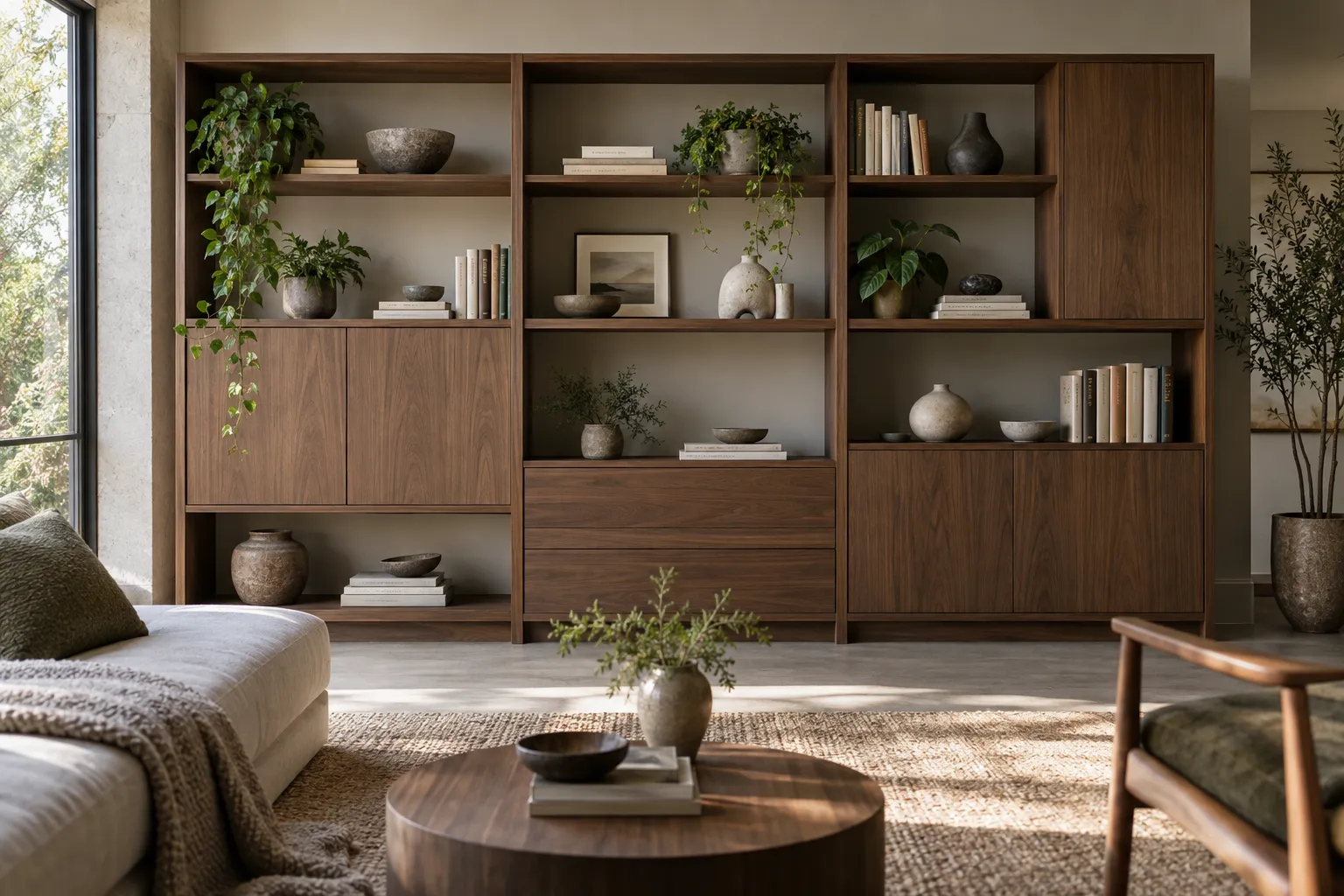
Open shelves make objects visible and can give a room depth. They also expose visual clutter and require dusting. Closed units can calm a busy wall and protect less attractive supplies, but too much solid cabinetry may feel heavy. The balance should follow what the household owns. Books and a few meaningful objects may earn display; cables, paperwork, and miscellaneous equipment may be better behind doors.
Use closed storage strategically rather than repeating it automatically. Lower cabinets can ground a tall arrangement and hide heavy or awkward items. A few doors at eye level may reduce visual noise in a work area. If baskets are used, confirm they fit the shelf and are easy to lift. A basket that is too deep or too heavy can make contents less accessible than before.
Consider how the wall looks from a distance. A rhythm of open and closed sections can make the unit read as part of the architecture. Random distribution may feel unsettled once filled. Start with practical categories, then arrange them into a composition with a clear balance of light and solid areas.
Plan the load honestly
Books and records can be much heavier than they appear in a staged photograph. Check the maker's stated limits for shelves, brackets, and the overall system, and understand whether those limits depend on a particular installation method. A long shelf may need more support than a short one even if the material looks substantial. Do not fill a decorative unit with heavy collections simply because it has enough physical space.
Place heavier objects low and distribute them rather than clustering them at the highest level. Check that doors and drawers operate smoothly after loading. If a shelf visibly bows, the arrangement needs attention. For wall-mounted systems, the wall and fixings must be suitable for both the unit and its intended contents; seek qualified advice when uncertain.
Safety matters beyond weight. A freestanding unit should not be easy to tip, particularly where children or pets are present. Follow current product instructions for anchoring and assembly. A beautiful shelving wall is successful only when people can use it without treating it as fragile scenery.
Compose the wall around a clear rhythm
Shelving is seen as a grid, a set of lines, and a collection of objects. Varying every shelf height can make the composition feel busy; repeating one height everywhere can fail the contents. Choose a few useful dimensions and let them form a rhythm. A larger opening for art or a lamp can give the eye a pause among smaller book bays. The design should have an order that remains visible when objects are added.
Think about the wall's relationship to furniture. A low cabinet line may align with the top of a sofa or desk, while taller shelving can frame a doorway. Avoid creating a unit that crowds seating or makes a narrow room feel enclosed. Paper templates or tape can help test the main divisions before committing to an installation.
Do not style every shelf to the same density. Some sections can hold books closely; others can display one object with generous space. Group items by use and visual weight. A meaningful arrangement should emerge from the real collection, not from a rule that every compartment requires a plant, a vase, and a stack of books.
Use material and finish to fit the room
Timber, metal, painted surfaces, and mixed constructions create different visual weights. A dark frame can outline the shelving as a graphic element; a finish close to the wall color may make it recede. Natural wood can add warmth, but its tone should be considered beside the floor and other furniture. Ask for samples when possible, especially if the unit occupies a large part of the room.
Finish also affects care. Open shelves collect dust, and delicate surfaces may mark when books are moved. A robust finish may be better for a working library than one intended mainly for display. Check cleaning guidance and whether damaged components can be repaired or replaced. The material should support the way the unit will be handled.
Lighting can make a shelving wall attractive after dark, but it should not be added automatically. A nearby lamp may be sufficient. Integrated lighting introduces wiring, controls, and maintenance needs; have any fixed electrical work handled by qualified professionals. The objects and structure should work well in daylight before light is used to dramatize them.
Make a plan for change and maintenance
Once the system is installed, use it for several weeks before filling every opening. Notice which books are reached often, where items get left, and whether the closed storage is easy to use. Adjust shelf heights or categories while the arrangement is still simple. Modular furniture is most valuable when its adaptability is exercised thoughtfully, not when it is treated as fixed from day one.
Keep a record of the system's model, components, load guidance, and installation method. Save spare hardware and instructions. If a module is added later, confirm that it is compatible with the version already installed. Do not assume that a visually similar component is structurally interchangeable. Periodically check stability and condition according to the maker's guidance.
Cleaning access matters too. Can you reach the highest shelf safely? Can a vacuum get near the base? Does an object need to be moved every time a door opens? These details determine whether the wall continues to feel ordered once the novelty of installation has passed.
Review the display occasionally as belongings change. If every open bay becomes packed, the solution may be to move some objects into closed storage or let go of duplicates, not to add another column automatically. If a shelf is consistently empty, it may be too high, too deep, or poorly placed for the objects you own. Reconfiguration should respond to these observations. A module that once held media equipment might later support books or a small work area, provided its structure and dimensions allow it. This ongoing editing keeps the system aligned with the household instead of turning it into a monument to its original layout.
Choose a system with a clear job
Before buying, summarize the brief in one sentence: "This wall must hold a working book collection and hide office supplies," or "This unit should divide the living and dining areas while preserving light." Then compare candidates against that job. Ask for dimensions, load information, configuration options, replacement parts, and installation requirements. A flexible system is only useful if it performs the current task well.
Mock up the intended height and depth in the room. Open nearby doors, sit in adjacent chairs, and look toward the window. Check the largest objects against the proposed modules. If a candidate fails these ordinary tests, its sculptural appeal is unlikely to compensate once the wall is full.
The best modular shelving gives belongings a durable structure while leaving room for life to change. Measure carefully before ordering any extra component. It can make storage feel like architecture, but its beauty depends on honest dimensions, safe support, and a composition that remains useful when the collection evolves.
Buy for your real objects, confirm structural requirements, and reserve room to rearrange.
These are general design considerations. Product dimensions, materials, installation requirements, and care instructions should be checked with the relevant maker or professional before purchase or work begins.